One difficult aspect of teaching grammar is the disjointed impression given by a series of grammar lessons: when going over the difference between the gerond and the infinitive, for example, we tend to give students a long series of sample sentences showing when one form is used rather than the other. When talking about...Read more »
Tags: 20th Century, Culture & Politics, Downloads, Grammar, Literature & Language, Partners, Pop Culture
Posted in Advanced, Culture & Politics, Grammar, Literature & Language, Reading, Writing | No Comments »
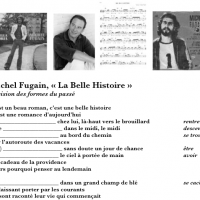
Michel Fugain’s 1972 song “Une Belle Histoire” has become a classic ballad of summer vacation, travel, and youth. The musical style is pretty dated, but that only adds to the kitchy fun of the song. It also happens to use several forms of the past tense, so I created one of my signature fill-in-the-blanks...Read more »
Tags: 20th Century, Culture & Politics, Downloads, Imparfait, Materials, Music, Pronominal Verbs, Raconter
Posted in Advanced, Imparfait, Intermediate, Music, Passé Composé, Plus-que-parfait, Verbs | No Comments »
It was in a graduate course on advanced French grammar topics that I had an ahha! moment: one of the most simple and easy exercises to create to improve writing is to closely study and reword sentences that students have already written. There is no better way to tailor a writing workshop to the...Read more »
Tags: Course Prep, Grammar, Partners, Writing
Posted in Grammar, Group Work, Sentences, Writing | No Comments »
I’m teaching a summer course at the moment, and while the students are quite interested in Rodenbach’s dark novel, sometimes the sun and heat call for a quick break from the novel’s grey and foreboding atmosphere. Charles Trenet’s “La Mer” is a classic, with its nostalgic 1940s sound that builds to a final stanza...Read more »
Tags: 20th Century, Description, Downloads, Music
Posted in Adjectives, Music | No Comments »
Le Cadavre exquis is a surrealist game the group invented in the 1920s. To play, one person writes a word or sentence on a piece of paper and then folds the paper to hide his contribution and then passes it to the next player. He does the same, then passes the paper, and so...Read more »
Tags: 20th Century, Grammar, Group Work, Partners, Writing
Posted in Advanced, Imparfait, Intermediate, Passé Composé, Sentences, Verbs, Writing | No Comments »
Many instructors of French shy away from literary analysis in elementary and intermediate language classes. To be sure, discussion of literary theory can be difficult even in advanced courses. It can be daunting to aim to read texts and analyse them when even the basic verb tenses are still unclear. But it is important...Read more »
Tags: 19th Century, Futur Simple, Literature & Language
Posted in Intermediate, Literature & Language, Oral Exercises, Poetry, Reading, Verbs | 2 Comments »
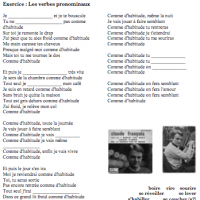
Most students will recognize the melody of “Comme d’habitude” because it is that of “My Way,” but few will know that the song made famous by Sinatra is actually a remake of the French song by Claude François. The original song shares no lyrical content with the English version: it’s a song about one...Read more »
Tags: 20th Century, Culture & Politics, Music, Pop Culture, Pronominal Verbs
Posted in Intermediate, Music, Verbs | No Comments »
Need a quick activity idea to get students speaking to each other? Bonus if the activity is a quick review of some grammatical terms? Enter Mad Libs, that fill-in-the-blanks game that most students will be familiar with from their childhood. Mad Libs has seen a recent comeback among adults and I’ve even spotted them...Read more »
Tags: Downloads, Grammar, Group Work, Partners, Warm-Up
Posted in Adjectives, Adverbs, Group Work, Materials, Prepositions, Pronouns, Verbs, Writing | No Comments »
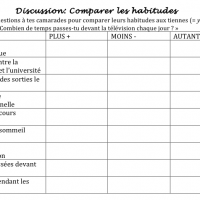
This is a quick warm-up activity I use to review comparative adverbs (plus, moins, autant). It’s in the format of one of the most successful kind of oral exercise: a table to “find someone in the class who…” You can download the pdf here. The single-page file prints two identical tables, which means half...Read more »
Posted in Adverbs, Elementary, Oral Exercises | No Comments »
When learning adjectives in an elementary language course, I often use examples from the visual arts to create a comparaison exercise. Two paintings that lend themselves well to this kind of exercise are Manet’s Déjeuner sur l’herbe (1862-1863) and Monet’s painting of the same title (1865-66). Manet, Déjeuner sur l’herbe, painted 1862-1863 Monet, Déjeuner...Read more »
Tags: 19th Century, Adjectives, Art History, Comparing, Culture & Politics, Description, Painting, Visual Arts
Posted in Adjectives, Adverbs, Elementary, Visual Arts | No Comments »